
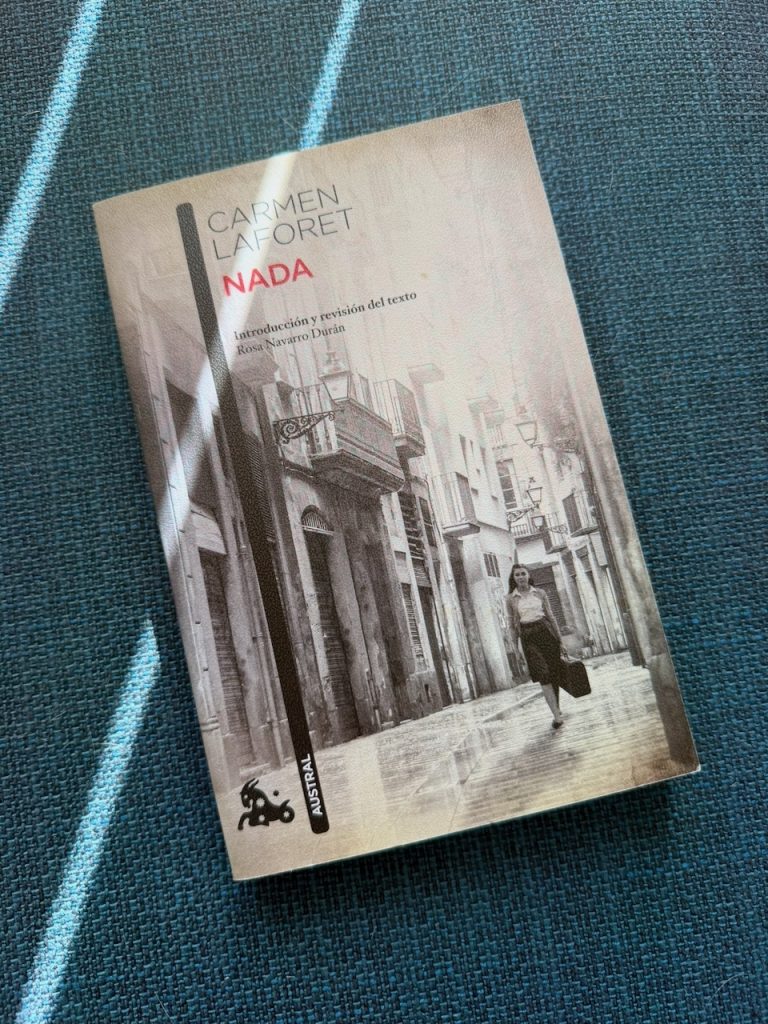
| ACQUIRED | Purchased from La Buena Vida (Calle Vergara No 5, 28013, Madrid) |
| FORMAT | Paperback |
| LENGTH | 364 of which about 70 are a lengthy and academic introduction |
| FIRST PUBLISHED | 1944, 2007 (English translation) |
| GENRE | Classics, existentialism, contemporary fiction |
Spanish readers will recognise this title straight away; it is a modern classic of Spanish literature and is often required reading in Spanish schools. That is in fact how I know it – my sister had her school copy in our room. I don’t remember ever seeing her reading it but she must have done at some point. … Right? I do remember picking it up myself. Something always came up and I was never able to read it despite my intentions.
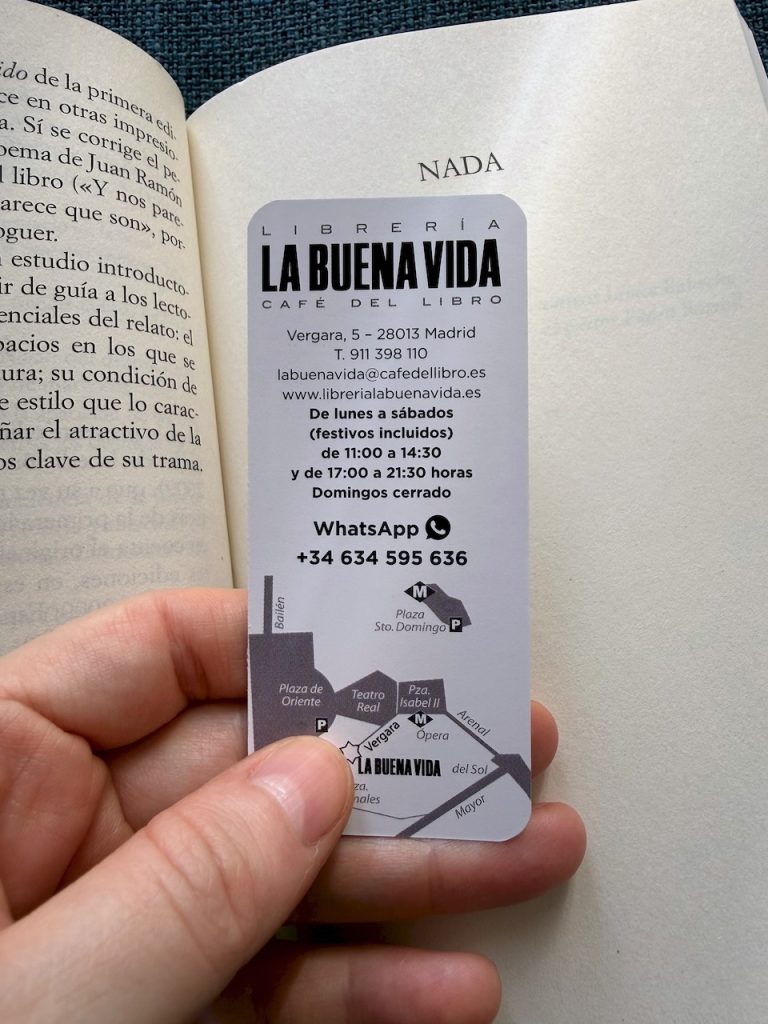
This specific copy I bought in 2023 when Declan and I spent a few days in Madrid. We were making our way to the Royal Palace when I saw this corner bookshop, went in on a whim and asked for a copy of Nada. The bookseller apologised profusely as they had sold out of some special edition of the time – I think for the centenary of the author’s birth, perhaps – and all they had was this normal one. There is something about Spanish bookshops and their knowledgeable keepers that I can’t help but love. Now in the present day when I finally opened this book to read, I found the shop’s branded bookmark inside the paperback and it brought me back to this kind interaction. I wish I’d had the time and luggage space to do some more extensive browsing when I was there! The bookshop was La Buena Vida (Calle Vergara No 5, 28013, Madrid). If I lived locally I think I would be there all the time.
A postwar coming-of-age story
The basic plot of Carmen Laforet’s Nada (‘nothing’, in Spanish) is deceptively simple: it tells the story of an 18 year old orphan who moves in with her relatives in Barcelona to attend university. Her innocent eagerness for this new stage of her life is quickly shattered on her arrival to the house on Aribau Street, where her relatives live.
Repulsive, repellent, revolting. Such are the words that came to mind as I read about this grotesquerie of characters. What once were normal people are now irrevocably damaged by their experience of the Spanish Civil war. Andrea is thrust into the violence and delusions, the abject poverty of this once middle class family, whilst she navigates another very different world, university life and her new growing friendship with Ena.
Impressions
I absolutely loved this novel and I just couldn’t get enough. I read it very quickly. I’m not usually a fast reader because I like to savour the narrative but there was no avoiding it in this case as it’s such a short book! The story is told in the first person from Andrea’s point of view. It is almost devoid of a plot with its heavy focus on the characters themselves in their oppressive, sordid environment. Andrea is more of an observer than a participant. What makes the book unusual for me is that her descriptions of settings and events are like expressive brushstrokes that loosely sketch out a scene rather than detailing every leaf and eyelash. Like an impressionist painting and with just as much richness. I can see in vivid detail in my mind scenes from the novel that, if I were to check the text again, were probably described with some economy of words. The result is a sophisticated and lyrical, surprisingly complex work – and really quite short. Too short? Nah, as a sort of snapshot of a year of a young person’s life, it is just the right length.
Something about the style reminded me of Sylvia Plath’s published journals. The earlier part of them at least, or how I remember them (it’s been so many years since I last read them…….) I suppose it might be because of how intensely dark the book gets. There is also a lot of beauty. Laforet’s skilful depiction of the passage of time with its seasonal colours and festivities, the city itself, the view from balconies and windows. I haven’t stopped thinking about Nada since I finished reading it. It gave me all the feels. Actually, it made me angry. And I loved every bit of it. There is so much to it, so much I want to say but I don’t want to make this blog post overly long or veer into spoilers. So, for now at least, I won’t.
One thing I will say – it is a book of its time even if it is considered modern for its time. Nada was written during Franco’s dictatorship, when all published works had to pass through the censor’s office and comply with the morality of the time. This one feels a bit like it passed through the cracks by means of alluding to things rather than mentioning them outright. But it still feels like a different time. There is a passage in the book in which Andrea is introduced to a group of college students. She is the only woman in the group and all of them but one is a brand new acquaintance. Yet they still ask her to make them sandwiches and coffee, and she seemingly thinks nothing of it! I’d like to think that a 2026 version of Andrea wouldn’t be making sandwiches for strangers.
Leave a Reply